Egyptian Novelist Shady Lewis on Coptic Identity, Church-State Relations, and Citizenship
Author: Nevine Abraham
Publication Date: 7/12/2021
Source: Arablit & Arablit Quarterly
For the reader interested in Coptism, Egyptian novelist Shady Lewis’s three novels Turuq Al Rab (Ways of the Lord, 2018), Ala Khat Greenwich (On the Greenwich Line, 2020), and Tarikh Mugaz Lilkhaliqah wa Sharq Al Qahira (A Brief History of Creation and East Cairo, 2021), delve into Coptic identity and its national and religious trappings through a perspective that does not limit it to the customary persecution narrative. Lewis voices a grievance against a predominant culture of fear, coercion, and repression, orchestrated primarily by the state and secondarily by the church, and gestures to the effects of social and colonial history, the Coptic Orthodox Church’s teachings and policies, its relation to the state, and the interactions with Western missionaries in shaping Coptic identity.
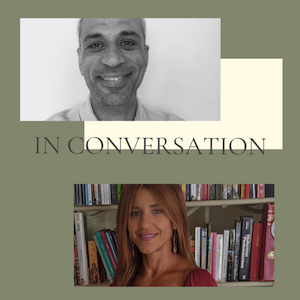
In this conversation, which took place in November 2021 over Zoom, Lewis addressed these topics and their relation to his three novels. The translation of this interview, conducted in Egyptian dialect, is mine.
Nevine Abraham: You have been living in England for 17 years. Did you choose to leave Egypt or was it a forced exile?
Shady Lewis: I was married to a German and our plan was to leave Egypt. This plan went at a faster pace than expected, and we left quickly because of the unstable situation there, similar to the experience of the protagonist in Ways of the Lord.
NA: So, is Ways of the Lord an autobiography?
SL: No, none of my novels is 100% an autobiography. My three novels draw on real events, but are rather a fictionalized autobiography. Every detail that is not credible is based on a real event; as for those that are credible, they are rather fiction.
NA: Was there a Coptic or a non-Coptic writer who shaped or impacted your writing?
SL: I would say [Edwar] Al Kharrat impacted my writing. However, his approach to Coptism differs from mine. He focuses on Coptic identity as an extension of history. Whereas his approach is more abstract, mine places Coptism in its social context and development. Also, Philip Roth, a Jewish-American writer, has strongly inspired and influenced my writing. He focuses on his Jewish identity and what it was like to be a Jew growing up in the 70s and 80s in the United States. His novels are a series where the protagonist carries the same name. Similarly, I have attempted to keep the same character, though not the same name, of the protagonist in my three novels. Generally, in Egypt, the Coptic voice is frowned upon. The circle of novelists with whom I am in contact are leftist intellectuals, and society confuses leftism with secularism whose sole interests are social justice and the working class. It denounces the concept of minorities and identity politics for fear of dividing people and diverting from the leftist’s mission. Apart from that, Egyptian society favors writing about the broader human experience that encompasses all groups regardless of their faith, and thus disapproves of writing about a minority like Copts. Writing about a Coptic experience limits the writer and inhibits readers from sympathizing with the protagonist. A friend of mine, who reads my chapters upon their completion, often advises me to not limit myself to writing about Coptic identity. My response is that this is the topic that interests me, and writing about it is rare. In recent years, there have been a few who have begun writing about it more courageously.
NA: In my opinion, many writers avoid tackling Coptism from your angle because the Coptic church teaches us not to criticize the church or priests, and to obey because, as the popular Coptic teaching goes, “Those who obey will be blessed.” In the meantime, Coptic writers in Egypt would fear any accusation of causing an internal anarchy within the church. This leads me to my next question: Have you faced any backlash by either priests or Copts, whether in Egypt or in England, because of your novels?
SL: Not really. There was an interesting coincidence when I published Ways of the Lord, where the director of the Associated Press in Egypt asked to write a report on it, which was later translated into many languages and featured in many newspapers worldwide. One month later, the Bishop of the Roman Catholics in Jerusalem praised the novel on Facebook. I am not sure if he read it, but he probably based his opinion on the AP report. Otherwise, there have been no objections to any of my novels: the distribution of books in Egypt is low and thus the impact is limited. It is rare for the novels to reach the church.
NA: I am surprised that your novels did not face any backlash, because they harshly, though subtly, criticize the church and priests for their abuse of authority and programming of Copts, and deal with the internal struggle of Copts within the Coptic community, in addition to the Copts-Muslims relations, albeit it being a side issue.
SL: Yes. I was careful not to be harsh in my criticism of the priests because at the end of the day they are a small part of this big game and do not create it. The state is the main player since it instills the rules and laws that decide the church’s legal authority. Some Coptic writers have described the church as an absolute evil.
In Ways of the Lord, I sympathize with the priest and depict him as a mere employee who performs his duty, similar to a ma’thun, and who helps Sherif get married upon his release from prison at the end of the novel. I took a fair stance in showing the complexity of the situation and the absence of a pure evil or good. The church makes inconsequential compromises because it needs the state’s protection as it is under its control. The state can harm and punish it, but can also not force it into doing anything and ultimately put it in danger. When Sadat exiled pope Shenouda III, some Copts stopped attending church. Copts in the US may protest and exercise pressure on the Congress to intervene, but these actions are not consequential enough, and the church as a mere institution like any other with a limited space of freedom has no choice but to submit to the state.
NA: Which topics do you like to focus on in your writings?
SL: The impact of the church-state relations on the creation of a subjective Coptic identity, as an Egyptian citizen first, and a Coptic citizen second, under a system of control that produces the limitations of this citizen. This raises the question of citizenship: Is there an acknowledgement of the Copt as a full citizen? In Ways of the Lord, Christians are mistaken for being Jews and are accused of spying for Israel, which demonstrates the lack of recognition of Copts and their conflation with other minorities. Meanwhile, they are expected to serve in the army and die for their country. They pay a full price without proper recognition. These are the issues that I attempt to address.
In Ways of the Lord, Christians are mistaken for being Jews and are accused of spying for Israel, which demonstrates the lack of recognition of Copts and their conflation with other minorities. Meanwhile, they are expected to serve in the army and die for their country. They pay a full price without proper recognition.
I focus less on the issue of persecution by the other so-called monster, because the real oppression derives from within the Coptic Orthodox church, on the one hand, and from the state whose interest is to scare the Copts with that monster, on the other hand. The state perpetuates the belief that the Copts are safe thanks to its security forces, which protect them from falling prey to that monster. In the end of Ways of the Lord, no one causes Copts or the church any harm on the Friday of Anger on January 28 of 2011, four days into the Egyptian uprising when there was no public security. I have a priest friend who lives in an apartment above the church in Ezbet el Nakhl. He found himself one night during those 10 days having to respond to a crowd carrying swords and knocking at his door at night. He thought they were there to kill him, but when he opened the door, to his surprise and disbelief, the crowd was assuring him that they were there to protect him and that he should not fear for his and his family’s lives during the unrest.