Repeated Turkish shelling threatens Christians of Syria’s Tel Tamr
Publication Date: 8/9/2021
Source: North Press
80-year-old Assyrian Elshwa Youssef heads to her neighbor’s house in the middle of her village, Tel Tawil, west of Syria’s Tel Tamr, after Turkish forces and Turkish-backed armed Syrian factions shelled the area.
On August 29, the Assyrian villages around the Khabur River were subjected to heavy bombardment, which resulted in massive material losses which drove the residents to flee before they returned once again.
Weeks ago, Turkish forces and pro-Turkish Syrian factions escalated the shelling of Tel Tamr, Abu Rasin, and their countryside, north of Hasakah, with artillery and missiles, reaching Ain Issa town in the countryside of Raqqa.
On Sunday, Turkish forces and pro-Turkish factions targeted the villages of al-Nuwaihat and Khadrawi, north of Abu Rasin, with more than ten mortar shells.
The bombing resulted in material losses to the residents’ property after about a week of calm.
“I was sitting in my house when the bombardment started; I fled to my neighbors’. They were shelling heavily,” Youssef, who lives with her relatives after her husband died three years ago and her children emigrated, said.
“We were frightened and shaking. We could die out of fear,” she added.
Damaged crops
In February 2015, Assyrian villages suffered from violence when ISIS destroyed dozens of villages on the banks of the Khabur River and abducted 230 Assyrians, who were later released after the community paid a ransom.
That incident caused the emigration of thousands of Assyrians, where only 1,200 of them are left out of 20,000 in the Hasakah region, according to Assyrian statistics.
Despite her attachment to her land throughout the war, Youssef indicated that she will leave to Canada to join her children, saying “I will leave and won’t return.”
The Assyrian villages on the banks of Khabur River were famous for cultivating summer and winter crops, but the war conditions two years ago completely destroyed the agriculture on the frontlines because of the farmers’ fears of repeated bombardment on the region.
A woman in her fifties, who refused to speak on camera for personal reasons, said that this year they planted vegetables, “but they were damaged because we were unable to water them due to the bombing.”
During the past year, Turkish bombing burnt wheat and barley crops, according to local residents.
At the beginning of this month, Turkish forces targeted the villages of Kozaliya, Tel al-Laban, and Umm al-Khair, in the western countryside of Tel Tamr near the M4 Highway, with more than 10 shells.
Destroyed houses
Unlike Youssef, the 50-year-old woman standing at her doorstep said that “Turkey aims to empty our villages, but this is impossible.”
“How will I leave the house that we just barely managed to build and the village in which we grew up?” she wondered.
The noise of generators breaks the silence of the village, which includes more than a hundred houses, but its remaining population is currently estimated at just 40 people.
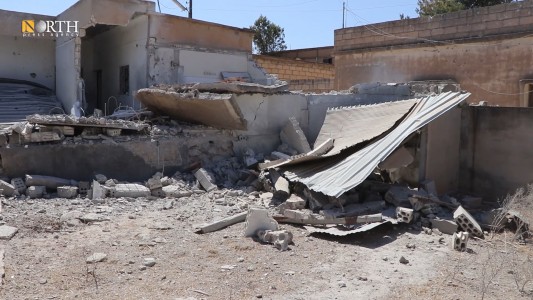
Eight houses have been totally destroyed due to the bombing, and some houses are partially destroyed as a result of shrapnel, according to the residents of the village.
The owners of the destroyed houses headed towards the town of Tel Tamr and Hasakah city, or to empty houses in the neighboring Assyrian villages.
In the nearby village of Umm Waghfa, the situation of the residents is not different from that of Tel Tawil, which was recently affected by the Turkish bombing.
Most of the doors of the houses in Umm Waghfa are locked after their owners left, while the church of the village, which is called St. Quriaqos, has not opened its doors since the arrival of the Turkish forces to its outskirts in 2019.
In the house parallel to the village church, 65-year-old Iliya Esho lives with his wife and two children, while another traveled abroad.
“We have closed the church since the arrival of Turkey to the outskirts of our village, and there are no priests and deacons here,” said Esho, who is currently taking care of the church.
“The church does not open its doors except for visits and funerals only,” he added.
During the recent Turkish bombardment, several shells fell on the village, and their shrapnel flew into the church hall and also affected houses in the village.