Family of murdered Coptic man forced to leave North Sinai, faced online threats
Author: Basma Mostafa
Publication Date: 26/5/2021
Source: Mada Masr
Shoes and a phone were what Peter Habashy found on the street in front of his father Nabil’s house in Bir al-Abd, North Sinai, after the neighbors called him and told him they’d heard gunshots last November. Nabil Habashy had been kidnapped earlier that evening.
The Coptic family later received a phone call from the kidnappers, according to Marina Habashy, Nabil’s daughter. They asked for a ransom payment of LE3 million, which they called a jizya (a tax Muslim emprires historically levied on non-Muslim residents). They said if they didn’t have the money within 48 hours, they would behead Nabil, Marina told Mada Masr.
Five days after Nabil’s disappearance, the kidnappers contacted the family once again to raise the payment from LE3 million to LE5 million. Contact between the kidnappers and the family continued until this past January, when communication was cut off following a call about how to deliver the payment and secure Nabil’s release.
Nabil’s family filed reports with various security agencies in Sinai, but the reports didn’t go anywhere. The family also reached out to Egyptian media outlets but, Marina says, “No one took interest, only the Christian channels. We relied on publishing on social media. We just wanted to know anything about our father or for someone to help us.”
A devout Christian, Nabil had also built the town’s only church, Marina says. After he was kidnapped, residents of Bir al-Abd came to refer to him as “the Nightingale.” After three months without communication, Nabil appeared in a video online saying: “I’ve been kidnapped for three months.”
Security forces asked Nabil’s family to leave North Sinai in January 2021. Now, Marina and 10 of her family members live in a two-bedroom apartment. They are not allowed to return to Sinai, and their homes and possessions there are vulnerable to looting and theft, which many other Coptic families that had to leave the area have experienced, according to EIPR.
“Security forces left us on a road in the city of Ismailia with nothing,” Marina says.
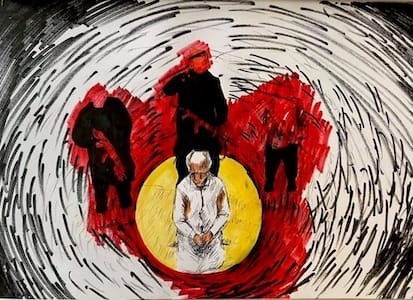
The family did not learn of Nabil’s death until they saw a video, released by the Province of Sinai on April 18, 2021, showing his execution by firing squad. The video also included a message threatening Egypt’s Copts for their support of the military.
“All that time since we’d lost contact, we were waiting for the moment we’d see him again,” Marina says.
A few days after the Province of Sinai announced Nabil’s death, the Interior Ministry announced the death of three armed militants and the pursuit of three others who were described as part of a cell involved in killing Nabil.
For years, militants fighting the Egyptian military in North Sinai have targeted Coptic Christians. In March 2021, the Province of Sinai killed Sobhy Sameh Abdel Noor in the far west of the Sinai Peninsula, according to the Sinai Foundation for Human Rights. Adib Nakhla was kidnapped in January 2019 at a Province of Sinai checkpoint on the international road west of Arish. The group later declared responsibility for kidnapping and killing him.
The Egyptian Initiative for Personal Rights estimated that 16 Copts had been killed in North Sinai because of their religious identity between the onset of the January 25 revolution and 2018.
Dozens of Coptic families moved out of the area in 2017 because of the violence. But the displaced families found that Copts were targeted outside of North Sinai as well. Militants in the village of Abtal in Ismailia kidnapped 63-year-old Bakheet Aziz and his relative, 35-year-old Youssef Samaan, at gunpoint in August 2020. They were released in January 2021 after their families paid a ransom of LE4 million for each of them.
It wasn’t the first kidnapping that family experienced, a relative who asked to remain anonymous spoke with Mada Masr. “Bakheet’s 28-year-old son Osama four years ago — a ransom of LE10 million was paid in full, but then we heard nothing about him. Later the family heard from security forces and the kidnappers that he had died during armed confrontations in Mount Halal.”
Some families returned to North Sinai in mid-2019 following Operation Sinai 2018, in which the military gained control over the outskirts of Arish and was able to limit the Province of Sinai’s movements within residential areas.
To avoid being targeted by militants, many Copts now try to be invisible, to not differentiate themselves from Muslims in any way, according to the director of the Sinai Foundation for Human Rights. Women and girls cover their hair for safety.
After Marina published a Facebook post saying that her father had been killed, she received hundreds of messages from users who identify as “jihadists.” The messages, which Mada Masr reviewed, include threats to murder and behead Marina and her family, and demands that she convert to Islam and marry a “jihadist.”